How Decorative Bronze Plaques Are Cast
A museum-sourced overview of relief planning, model development, casting and the finishing work that makes an image readable.
Read article ↗Independent craft publicationField notes · 2026
Explore traditional forging, decorative casting and the contemporary makers transforming raw materials into lasting objects.
Workshop safety comes first. Heat, fumes and powered tools require suitable training, ventilation, protective equipment and professional supervision.
Three ways into the workshop
A practical editorial index from first model to protected surface.
A source-led orientation to patterns, wax positives, molds, metal casting and the many finishing decisions that follow.
Open the field guide ↗CARVE02How relief, line and texture emerge through carving, chasing, engraving and careful tool control.
Open the field guide ↗FINISH03Surface color, sheen, patina and coatings as deliberate parts of an object’s design and maintenance plan.
Open the field guide ↗Featured stories
Six long-form explainers with publication dates, institutional bylines and linked primary sources.
A museum-sourced overview of relief planning, model development, casting and the finishing work that makes an image readable.
Read article ↗
Why section, link geometry, weld quality and intended load must be considered together.
Read article ↗
Following a relief through positive and negative stages without losing edge, texture or authorship.
Read article ↗
A careful vocabulary for natural weathering, intentional patination and protective coatings.
Read article ↗
How a modern emblem can use wings, heat and circular rhythm without inventing an ancient origin story.
Read article ↗
Scanning, modeling and machining can extend—not erase—the judgment of the modeler, founder and chaser.
Read article ↗From fire to form
Every workshop has its own sequence. This editorial map shows the questions that pass between designer, modeler, foundry, finisher and installer.
Define the object, context, sources, use and safety boundary before drawing.
Test silhouette, relief hierarchy, mounting and how light will describe the surface.
Build a physical or digital study and record scale, revisions and authorship.
Let a qualified workshop plan parting, support and the mold system for the chosen process.
Carry out hot work only in a controlled foundry with trained staff and suitable equipment.
Refine line and texture while preserving intentional evidence of the model and cast.
Test color and finish on a sample; document chemistry and application when known.
Check surface, joins, mounting, labels and maintenance records before release.
Hot metal, mineral dust, fumes, chemicals and heavy loads demand task-specific training, ventilation, protective equipment and qualified supervision.
Materials library
High-level material notes for editors, students and clients—never a substitute for alloy identification or engineering advice.
A broad family of copper-based alloys valued in sculpture for castability, strength and varied surface color.
Open material note ↗02 · Copper–zinc alloyOften chosen for warm color, machinability and decorative sheet or cast work.
Open material note ↗03 · Elemental metalDuctile and visually responsive to forming, hammering and changing surface color.
Open material note ↗04 · Ferrous metalCentral to forging traditions and capable of strong, expressive transitions in section and texture.
Open material note ↗05 · Iron–carbon alloy familyAvailable in many grades with different forming, welding and corrosion behavior.
Open material note ↗06 · Natural materialA varied category whose grain, porosity and fracture behavior shape carving and installation choices.
Open material note ↗07 · Process materialA model material that can record hand work, assemble sections and support lost-wax workflows.
Open material note ↗08 · Finish systemClear or pigmented layers used to moderate exposure and establish a maintainable surface.
Open material note ↗Central motifRelief depthBorderAnatomy of a decorative emblem
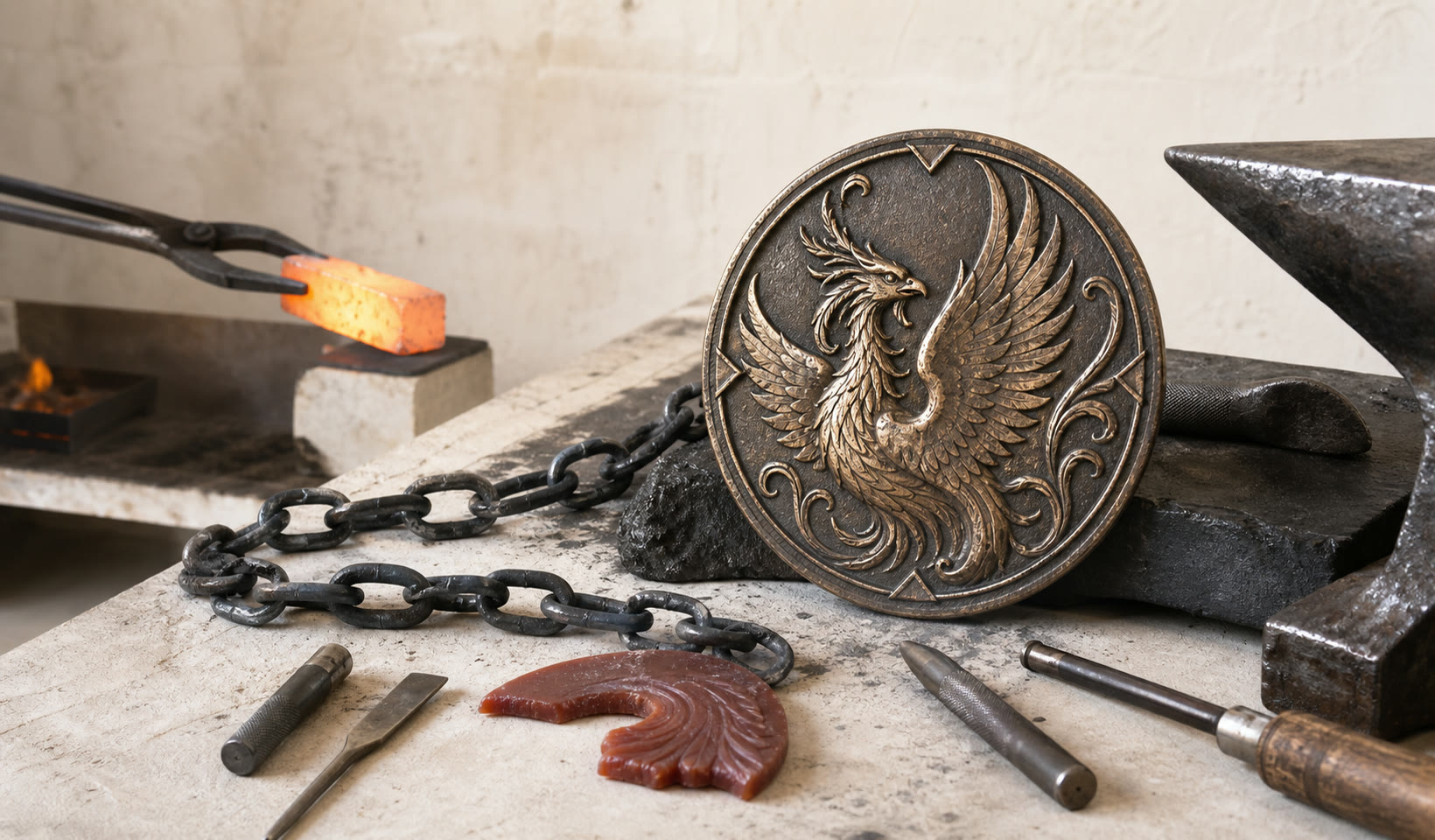
Our phoenix is a contemporary editorial motif—not an artifact and not evidence of a lost tradition. The design lets us name eight practical parts of relief work.
Verified workshop directory
These profiles use official public descriptions. Our illustrations are editorial studies and do not depict their work or facilities.
Fine-art casting, finishing, conservation and related sculpture services.
Founded as Bedford Bronze in 1932; the studio’s official history documents its development and current service to artists.Visit official site ↗Exhibitions, collections, metals studios and public education in fine metalwork.
The institution describes a mission to preserve, promote and advance the art and craft of fine metalwork.Visit official site ↗
Educational forging programs and preservation through use of historic Cambria Iron Company facilities.
The center publishes its workshop program, institutional mission and facility context.Visit official site ↗Illustrations: Forge & Ember Journal, original process studies. Institution information: linked official profiles. No endorsement is implied.
Workshop galleries
Original editorial illustrations created for this publication. They are visual explanations, not documentary photographs or fabrication drawings.
Research principles
We separate observed form from documented process, historical evidence from modern interpretation, and editorial illustration from a maker’s own work.
Museum essays, conservation resources, official studio records and current occupational guidance.
Unknown alloy, maker or treatment remains unknown until reliable documentation closes the gap.
Original, licensed or public-domain visuals receive a source and rights note.
Substantive corrections carry a date, explanation and link to the revised page.
Frequently asked questions
Questions that separate a useful orientation from unsafe or unsupported claims.
Forging changes solid metal through controlled force, often while heated. Casting introduces molten metal into a prepared mold. Both terms cover many processes, and neither description is a safe operating guide.
A plaque can be modeled, molded, cast, chased, colored and mounted. The exact route depends on alloy, scale, relief, edition, location and the capabilities of the selected workshop.
Patina is surface color or change produced naturally over time or intentionally in a workshop. A color should not be treated as proof of age, composition or a particular recipe.
No. The phoenix shown here is an original modern editorial illustration used to discuss composition and craft. We make no historical claim for its border marks or design.
No. They are educational overviews. Hot work, chemicals, powered equipment, dust and heavy objects require current procedures, training, ventilation, protective equipment and qualified supervision.
We begin with museum, occupational-safety, conservation and professional sources; separate observation from documented fact; link the sources used; and publish a correction route.
About the publication
Forge & Ember Journal is an independent pre-launch publication about decorative metalwork. It connects process, material, makers and visual culture without turning editorial content into workshop certification.
Articles currently use the transparent institutional byline Forge & Ember Editorial Desk. Named staff profiles will be published only after identity and responsibility are verified.
Last updated August 31, 2026